
Introduction
For millions of healthcare professionals, security personnel, factory workers, call center employees, drivers, and IT professionals, night shifts are a normal part of life. While working at night can be productive and financially rewarding, it often comes with one major challenge: staying alert when your body naturally wants to sleep.
That’s where coffee comes in.
Caffeine is one of the most effective tools for improving alertness, concentration, reaction time, and work performance during night shifts. However, many workers consume coffee incorrectly—either drinking too much, drinking it too late, or relying on it throughout the entire shift.
The result?
- Energy crashes
- Poor sleep after work
- Increased fatigue
- Caffeine dependence
- Reduced performance over time
In this guide, you’ll learn the best time to drink coffee for night shift workers, backed by sleep science and practical experience.
Why Night Shift Workers Need a Different Caffeine Strategy
Most caffeine advice is designed for people who work during the day.
Night shift workers face unique challenges because:
- Their circadian rhythm promotes sleep at night.
- Alertness naturally decreases between midnight and 6 AM.
- Sleep often occurs during daylight hours.
- Recovery can be more difficult.
Because of this, caffeine timing becomes even more important.
The goal isn’t simply to stay awake.
The goal is to:
✅ Stay productive during work
✅ Avoid energy crashes
✅ Sleep well after the shift
✅ Prevent caffeine dependency
How Caffeine Works
Caffeine blocks a chemical called adenosine.
Throughout the day (or night shift), adenosine accumulates in the brain and creates feelings of sleepiness.
When caffeine blocks adenosine:
- Alertness increases
- Fatigue decreases
- Concentration improves
- Reaction time improves
However, caffeine does not eliminate fatigue—it only temporarily masks it.
This is why timing matters.
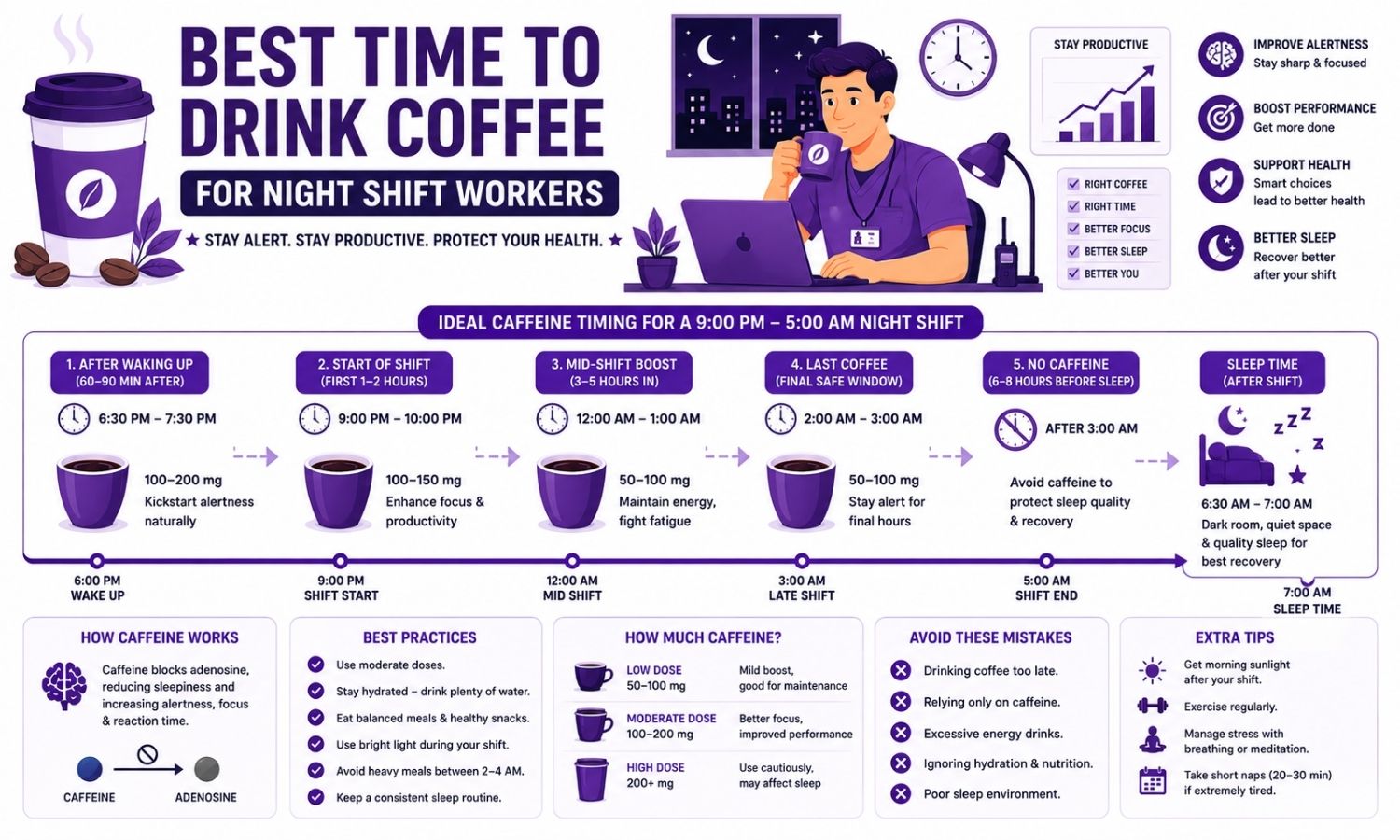
The Ideal Coffee Schedule for Night Shift Workers
Let’s assume a typical shift:
9:00 PM – 5:00 AM
Here’s the ideal caffeine strategy.
1. First Coffee: 60–90 Minutes After Waking Up
Best Time
6:30 PM – 7:30 PM
If your shift starts at 9 PM and you wake around 6 PM.
Why This Works
Your body naturally releases cortisol after waking.
Cortisol helps increase alertness naturally.
Drinking coffee immediately after waking isn’t always necessary.
Waiting 60–90 minutes allows your natural alertness to peak first.
Recommended Dose
100–200 mg caffeine
Examples:
- 1–2 cups coffee
- Strong tea
- Pre-workout (if exercising)
2. Second Coffee: Beginning of Shift
Best Time
9:00 PM – 10:00 PM
This is when work demands often increase.
Benefits
- Improves focus
- Supports productivity
- Helps prevent early-shift fatigue
Recommended Dose
100–150 mg caffeine
Avoid consuming large amounts immediately.
Moderate doses work better than caffeine overload.
3. Mid-Shift Coffee (Optional)
Best Time
12:00 AM – 1:00 AM
Many workers experience a drop in energy around midnight.
A small caffeine boost can help maintain performance.
Recommended Dose
50–100 mg caffeine
Examples:
- Small coffee
- Green tea
- Black tea
The goal is maintenance, not stimulation overload.
4. Last Coffee Before the Final Hours
Best Time
2:00 AM – 3:00 AM
This is usually the final safe caffeine window.
Why?
Caffeine remains active for several hours.
Drinking coffee too close to bedtime can severely impact sleep quality.
Recommended Dose
50–100 mg caffeine
This should be your final caffeinated beverage.
When Should Night Shift Workers Stop Drinking Coffee?
This is where most people make mistakes.
Rule of Thumb
Stop caffeine intake at least:
6–8 hours before your planned sleep time
Example
If you plan to sleep at:
7:00 AM
Avoid caffeine after approximately
11:00 PM – 1:00 AM
Some people metabolize caffeine more slowly and may need an even larger gap.
The Worst Time to Drink Coffee
During the Last Hour of Your Shift
Many workers grab coffee before driving home.
This often backfires.
Problems include:
- Difficulty falling asleep
- Reduced sleep quality
- Shorter sleep duration
- Increased next-day fatigue
Instead of caffeine, try:
- Bright light exposure
- Hydration
- Light movement
- A healthy snack
Best Coffee Strategy by Profession
Nurses and Healthcare Workers
Recommended:
- Coffee before shift
- One serving during first half
- Small dose around midnight
Avoid caffeine near the shift end.
Security Guards
Long periods of sitting can increase fatigue.
Recommended:
- Moderate caffeine
- Walking breaks
- Hydration
Avoid using caffeine as your only alertness strategy.
Call Center Employees
Mental fatigue is often more significant than physical fatigue.
Recommended:
- Coffee early in shift
- Small tea later
- Focus on hydration
Drivers and Transportation Workers
Safety is critical.
Recommended:
- Strategic caffeine before driving
- Bright light exposure
- Adequate sleep between shifts
Never use caffeine to compensate for severe sleep deprivation.
Coffee vs Energy Drinks
Many night shift workers rely on energy drinks.
Coffee Advantages
- Less sugar
- Lower cost
- Natural antioxidants
- Flexible caffeine dosing
Energy Drink Drawbacks
- Excess sugar
- Artificial ingredients
- Larger caffeine doses
For most workers, coffee remains the better choice.
Additional Tips for Night Shift Workers
Stay Hydrated
Caffeine should not replace water.
Aim for:
2–3 liters daily
Hydration improves focus and reduces fatigue.
Eat Balanced Meals
Avoid:
- Heavy fried foods
- Excessive sugar
- Large meals at 3 AM
Choose:
- Lean protein
- Fruits
- Vegetables
- Whole grains
Use Bright Light
Exposure to bright light during shifts can improve alertness.
Especially useful between
10 PM and 2 AM
Create a Sleep-Friendly Environment
After work:
- Use blackout curtains
- Wear an eye mask
- Keep your room cool
- Use earplugs if needed
Sleep quality matters more than caffeine quantity.
Common Coffee Mistakes Night Shift Workers Make
Drinking Coffee Continuously
Constant caffeine intake leads to tolerance.
Drinking Coffee Before Bed
One of the biggest causes of poor recovery.
Relying Only on Caffeine
Coffee helps, but it cannot replace sleep.
Consuming Excessive Energy Drinks
Large caffeine doses increase anxiety and sleep problems.
Sample Night Shift Coffee Schedule
Shift: 9 PM – 5 AM
6:00 PM
Wake up
7:00 PM
First coffee (150–200 mg)
9:30 PM
Second coffee (100–150 mg)
12:30 AM
Optional small coffee (50–100 mg)
2:30 AM
Final coffee (50–100 mg)
5:00 AM
End shift
6:30–7:00 AM
Sleep
This schedule balances alertness and recovery.
Final Thoughts
The best time to drink coffee for night shift workers is strategically spread throughout the first two-thirds of the shift, with caffeine intake ending several hours before sleep.
For optimal performance:
- Drink your first coffee 60–90 minutes after waking.
- Use moderate caffeine doses.
- Avoid caffeine in the final hours of your shift.
- Prioritize sleep and hydration.
- Use coffee as a tool, not a crutch.
When used correctly, coffee can help night shift workers stay alert, productive, and healthy while minimizing the negative effects of disrupted sleep schedules.